
Wastewater Treatment for Workforce Housing and Man Camps
Configurable decentralized treatment for dependable wastewater management beyond practical sewer access
Remote and temporary workforce housing may sit far beyond practical municipal sewer access, but every site still needs dependable wastewater treatment designed around its actual operating conditions, including variable occupancy, limited operator access, a constrained footprint, and requirements for discharge or reuse at the site.
Workforce housing developments, sometimes referred to as worker camps, worker encampments, or "man camps," particularly in the oil and gas industry, require an approach that fits both the housing plan and the surrounding infrastructure. Decentralized treatment places the system close to where wastewater originates, while giving project teams greater control over treatment capacity and effluent objectives. Fluence configures wastewater treatment for remote workforce sites around projected flows, influent characteristics, local conditions, and how treatment needs may change over the life of the project.

The Wastewater Challenges of Remote Workforce Housing
Public sewer connections may require long conveyance lines, pumping stations, easements, and coordination with a utility that cannot accommodate the project schedule.
Remote sites may also have little space left for wastewater equipment after land is allocated to housing, roads, utilities, and support facilities. Many don't have dedicated technical staff to operate a wastewater treatment plant.
Because treatment occurs near living quarters, planning needs to consider noise, odor, visual impact, operator workload, and the effluent quality required for discharge or an intended nonpotable application.
Why Decentralized Wastewater Treatment Fits Remote Sites
By definition, decentralized wastewater treatment locates treatment at or near the point of need rather than at a distant centralized plant. For remote sites, that can avoid the cost and complexity of extending long sewer lines while making it easier to phase capacity and reuse treated effluent close to where it is generated. It can also provide an alternative to hauling wastewater by tanker, which becomes increasingly difficult and expensive as site flows increase.
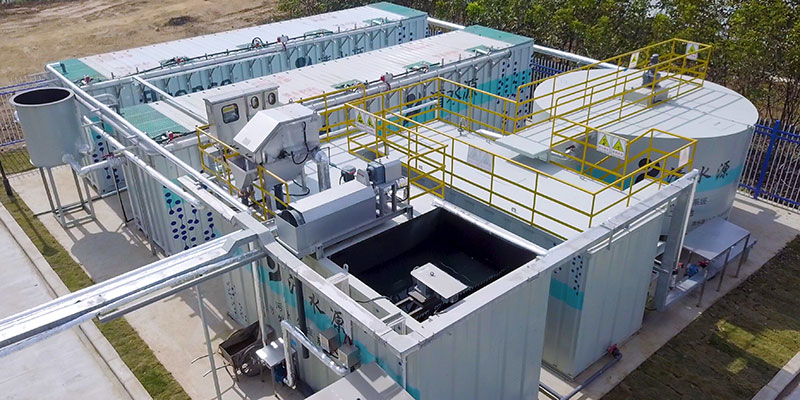
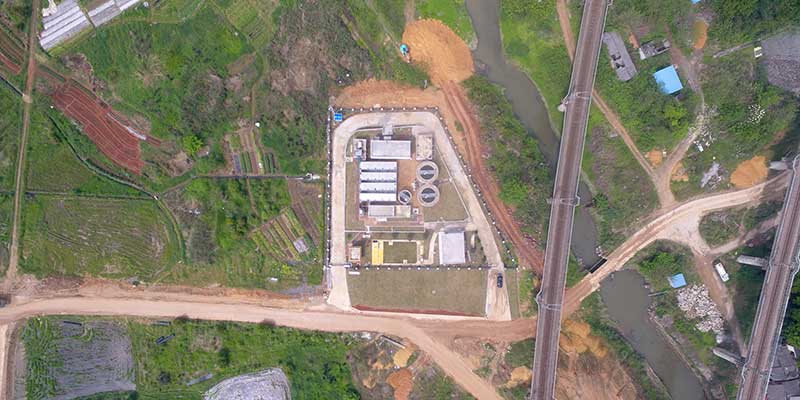
Remote workforce housing commonly relies on prefabricated or relocatable modular buildings and RVs arranged at the site. Factory-assembled, containerized wastewater treatment units can work well in the same types of phased, space-constrained projects.
Local treatment also lets capacity planning follow the development plan. Depending on the system and project design, a project can establish capacity for current flows and add treatment units as occupancy grows, matching the treatment arrangement to the project rather than committing to a full final buildout from the first day based on projections.
Treating wastewater close to where it is generated can also make local reuse more practical. When regulations and treatment requirements allow, treated effluent may be used for applications such as dust control or irrigation without sending wastewater to a distant treatment plant and then returning reclaimed water to the site.

Workforce Housing Applications Beyond the Oilfield
Oil and gas remains a prominent sector for workforce housing because rapidly developing fields can create demand where local sanitation infrastructure has little spare capacity. Similar conditions can arise at mining operations and major construction or infrastructure projects, while remote industrial and energy developments may also need temporary, phased, or permanent employee housing.
Each setting brings different wastewater characteristics, schedules, workforce patterns, and site constraints. Some projects also need drinking water production or a broader remote site water strategy. Fluence provides water solutions for workforce housing alongside wastewater treatment, allowing water supply, wastewater treatment, and potential reuse to be considered together.
Aspiral™ MABR for Workforce Housing Wastewater Treatment
For sites whose requirements align with the technology, an Aspiral™ Flex configuration using MABR brings biological treatment into weatherized steel units measuring 20 or 40 feet and tested at the factory. The Aspiral™ Flex product family can also incorporate MBR or activated sludge, so Fluence selects treatment blocks according to influent conditions, effluent targets, space, and operating requirements rather than prescribing one process for every project.
In the MABR configuration relevant to workforce housing, oxygen diffuses through membranes to support simultaneous nitrification and denitrification. The process provides biological nutrient removal through passive aeration at low pressure. Fluence MABR systems for small to medium capacities use up to 90% less energy for aeration than conventional treatment plants and can produce effluent that meets standards including California Title 22 and China's Class 1A.
The MABR configuration offers a compact footprint and low-odor, low-noise operation for sites close to housing. Multiple units can operate in tandem where needed for staged or increased capacity, and remote monitoring and operation can offer greater control.
Workforce Housing Wastewater Treatment in Carlsbad, New Mexico
A project in Carlsbad shows how the approach can work under actual oilfield housing conditions. MEC Services needed wastewater treatment for an RV park serving workers in the Permian Basin, where nearby infrastructure could not adequately handle the added demand. Fluence supplied a containerized Aspiral™ plant that treated sewage at the site rather than relying on expanded offsite capacity.
The treated effluent was reused on-site for dust control, turning a disposal requirement into a useful nonpotable water source for the project. Read the full Carlsbad workforce housing case study.
Choosing a Wastewater Solution for a Workforce Housing Project
A sound selection process starts with the wastewater load. How many people will occupy the site, what daily and peak flows will they generate, and could support facilities change the wastewater characteristics? Forecasts should capture startup, peak activity, seasonal shifts, flow variability, and planned expansion.
The project timeline then shapes the capacity strategy. Temporary, phased, expanding, and permanent housing may call for different equipment, civil works, ownership decisions, and provisions for future capacity. Teams also need to define the effluent objective before settling on a process. Surface discharge, subsurface disposal, and nonpotable reuse may involve different treatment levels, monitoring, permitting, and operating controls, depending on local requirements.
Finally, the site sets practical boundaries. Available area, power, collection piping, maintenance access, operator resources, schedule, climate, and future relocation plans can affect the configuration. Fluence evaluates those factors to determine whether Aspiral™ or another approach fits the project, then configures treatment around the required performance.
Need Wastewater Treatment for a Remote Workforce Site?
Whether you're planning new workforce housing, expanding an existing site, or replacing inadequate treatment, Fluence can evaluate the wastewater flows, site conditions, treatment requirements, and project schedule. Contact Fluence to discuss your workforce housing wastewater needs.


