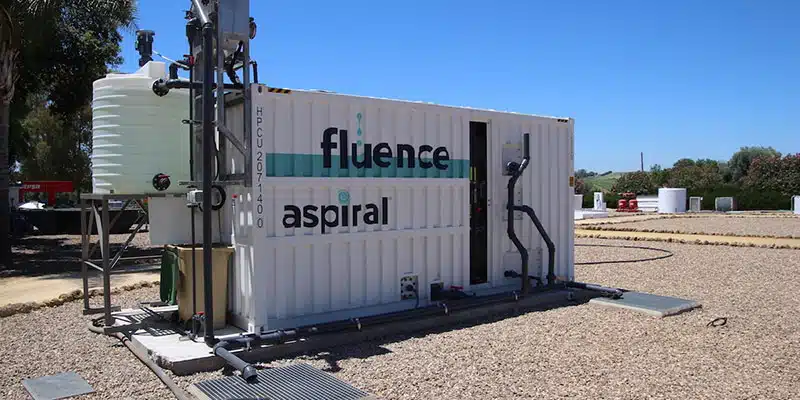
Aspiral™ Flex containerized wastewater treatment systems support fast deployment and scalable capacity for phased infrastructure delivery.
Fluence helps you align the right model with your project’s needs
Utilities and industrial operators no longer make water and wastewater infrastructure decisions on purchase price alone. They now weigh timing, staffing, growth curves, operating burden, and cash flow just as heavily, which is why financing capital improvements remains a top industry concern. For many projects, it’s not simply a question of what to build, but also of how infrastructure should be bought, owned, and operated. Fluence provides answers with conventional, owner-funded plants, timeline-based leasing, and full-service Water Management Services.
The broader comparison reflects real pressure in the market. Public owners face a long horizon of need for water and wastewater infrastructure, while water workforce shortages continue to strain daily operations, technical oversight, and project execution capacity. Industrial and commercial users face a parallel challenge. Demand can increase, discharge requirements can tighten, and waiting to build out capacity all at once can tie up capital before it’s necessary.
That is why the delivery model matters as much as equipment selection. Projects may need to move quickly or scale in stages, while also addressing a practical question: who will operate and maintain the asset over time? Fluence brings these decisions together early, pairing commercial structure with modular treatment, digital operations, and long-term service support.
Traditional CapEx Projects
In many cases, traditional CapEx procurement still fits. When an owner wants direct control over the asset, has capital available, and expects stable, long-term demand from Day 1, the conventional path can make sense. This approach typically follows a sequential design-bid-build structure, with the owner funding procurement, managing construction, and retaining operational responsibility after startup.
This gives the owner the h3est direct ownership position, but it can also create friction. Larger upfront capital commitments can compete with other priorities. Sequential procurement can stretch delivery timelines and push owners to scale for future demand today, when the near-term need is smaller. For projects with predictable flows, internal operating strength, and enough capital headroom, that trade can be acceptable. For projects facing uncertainty or staffing pressure, it may be harder to justify.
Leasing Keeps More Options Open
Timeline-based leasing works differently. It lowers the upfront costs, accelerates deployment, and preserves flexibility without committing to a long-term build-own-operate (BOO) contract. For smaller projects, early-stage expansions, or sites where future demand is still taking shape, a lease can be a better fit than committing to full ownership right away.
Fluence offers leasing and rental services that let the customer operate the plant or have Fluence operate it, with ownership transfer possible later, depending on the contract. That means leasing can solve an immediate treatment need without forcing a permanent decision about long-term ownership or operations.
Leasing also fits phased growth. When demand ramps up over time rather than all at once, Fluence can align project delivery and commercial structure so that customers add capacity as conditions warrant, rather than overbuilding at the start. For municipalities and commercial users alike, this can turn a large capital decision into a more manageable progression.
BOO With Water Management Services
Under a build-own-operate contract, Fluence finances, delivers, owns, operates, and maintains the plant while the customer pays for treatment service rather than making a full infrastructure investment upfront. Through Water Management Services, Fluence provides a full-service model for customers seeking to reduce their daily operating and capital costs.
This approach makes the most sense when the real challenge is not only funding the asset, but also carrying long-term responsibility for performance. WMS brings financing, design, construction, operation, and maintenance into one framework. This can be especially valuable for communities or industrial operators facing staffing limits, technical complexity, or pressure to move quickly. In those cases, an alternative delivery model can provide a practical path when the traditional owner-funded route is harder to execute internally. It also removes upfront capital burden while placing full lifecycle responsibility with Fluence under a performance-based agreement.
Fluence Changes the Comparison
The right commercial structure depends not only on financing, but also on the asset itself. For leasing and WMS contracts, Fluence doesn’t rely solely on conventional construction. It uses modular treatment systems and digital operation tools that can change how quickly a project moves and how efficiently it scales.
For example, Fluence’s Aspiral™ Flex wastewater treatment line uses factory-tested modular process blocks that simplify logistics, reduce site work, cut on-site labor, and support fast deployment and easier expansion for small- and medium-scale projects. That matters under any delivery model, but it becomes especially powerful when paired with leasing or BOO, because customers can align spending more closely with actual demand rather than paying for a full buildout before they need it.
Beyond deployment flexibility, Fluence brings a h3 operational advantage. Smart Operations supports monitoring, analytics, troubleshooting, optimization, and predictive corrective recommendations that help reduce O&M costs across manpower, chemicals, energy, reliability, and service life. So the question is not only how to fund an asset. It’s also who will keep it performing, and with what tools.
On the wastewater treatment side, Fluence has a h3 record with proven membrane aerated biofilm reactor (MABR) technology, which uses membrane-based nitrification-denitrification for exceptional nutrient removal, as well as low-pressure aeration that can cut aeration energy use by up to 90%. Systems can meet stringent treatment standards, including China Class 1A and California Title 22 reuse limits. This combination of lower energy demand and h3 effluent performance — matched with modular deployment — makes Aspiral™ Flex plants ideal for efficient phased operation.
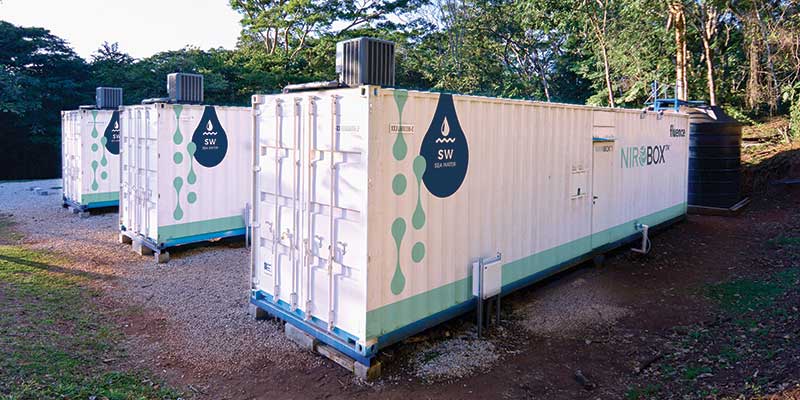
NIROBOX™ containerized water treatment systems support fast deployment, reduced site complexity, and scalable delivery for changing project needs.
For water applications, Fluence also supports flexible delivery with containerized and modular systems such as NIROBOX™, which can help customers accelerate deployment, reduce site complexity, and align capacity additions with actual demand.
Choosing the Right Fit
The best delivery model for your enterprise’s needs depends on a few practical questions. Who is funding the asset? Who owns it? Who operates it? How fast is capacity needed? Will demand ramp over time? How much long-term responsibility does the customer want to retain?
CapEx can fit owners who want direct control and can fund the full asset. Timeline-based leasing fits projects that need flexibility and a lower upfront commitment. BOO contracts fit customers who want treatment capacity and long-term performance without taking on the full infrastructure and operating burden themselves. To compare these paths against your capacity needs, staffing reality, and timeline, contact the experts at Fluence, who can help you find the perfect fit.


