
Nitrogen compounds are a major pollutant that must be removed from wastewater. Technologies like the MABR in Fluence's Aspiral™ Flex system can ensure high nutrient removal to meet the strictest effluent standards.
Stricter regulations, rising energy costs, and new treatment technologies are changing how facilities approach nitrogen removal
Although nitrogen is a nutrient critical for all life, too much of it in water presents dangers to ecosystems and human health. In response to an increase in nitrogen contamination, many nations are tightening regulatory standards for nitrogen compounds. At the same time, rising energy costs, operator shortages, and aging infrastructure make the task more challenging. But innovation in simpler, more scalable treatment systems has produced attractive options to modernize nitrogen removal. Here are some of the processes.
Biological treatment remains the most widely used approach for nitrogen removal. These processes rely on naturally occurring microorganisms to convert nitrogen compounds into harmless nitrogen gas or incorporate them into biomass. Common biological technologies include:
- Activated Sludge (Nitrification-Denitrification): The most widely used biological process. Effective and well-established but typically requires significant aeration, energy, and operator oversight.
- Partial Denitrification-Anammox (PDNA) and Anammox: Advanced biological processes that reduce energy use and oxygen demand compared to conventional activated sludge. Best suited for wastewater with specific nitrogen characteristics and increasingly used in high-strength applications.
- Algal Treatment Systems: Microalgae remove nitrogen by incorporating it into biomass. These systems can reduce energy requirements but require additional harvesting and are best suited to certain climates and applications.
- Bioelectrochemical Systems: An emerging technology that uses microorganisms and electrical interactions to remove nitrogen. While promising, these systems remain largely limited to research and specialized applications.
In addition to biological treatment, some applications rely on physical and chemical processes to remove or convert nitrogen. Technologies such as electro-oxidation can be effective for certain industrial wastewaters or specialized treatment applications but generally involve higher energy or chemical requirements than biological processes.
What Has Changed in Nitrogen Removal
Many wastewater treatment plants and lagoons designed to meet earlier permit requirements now require upgrades to comply with today's stricter nutrient limits, but higher energy costs and limited operator availability have increased demand for systems that can deliver advanced treatment in a targeted, scalable way.
For many projects, the most practical solution is not a full plant replacement. Communities and facilities might need to retrofit an existing plant, supplement a lagoon system, add capacity in phases, or install a decentralized treatment system closer to the point of need. Modular treatment platforms have made these upgrade strategies faster and more practical to implement.
Why Nitrogen Removal Matters More Today
Many states and municipalities are adopting stricter nutrient discharge requirements to combat harmful algal blooms, eutrophication, and declining water quality. As permit limits become more demanding, facilities are increasingly evaluating technologies that can improve nitrogen removal without significantly increasing energy consumption or footprint.
MABR: A Proven Technology for Nutrient Removal
Like conventional activated sludge, membrane aerated biofilm reactor (MABR) technology uses microorganisms to carry out nitrification and denitrification. However, instead of supplying oxygen through bubble aeration, MABR uses a self-respiring membrane with a large surface area to passively deliver oxygen. There are several advantages to this configuration.
Aeration occurs at near-atmospheric pressure using low-pressure blowers, significantly reducing the energy required compared to conventional bubble aeration. The membrane takes advantage of biofilm, a resilient, natural layer of microorganisms that forms on the membrane's oxygen-rich surface, where bacteria can use oxygen most efficiently. In bubble aeration, most air bubbles reach the surface before microorganisms can use them.
The conditions in the rest of the MABR tank remain anoxic, so the denitrifying anaerobic bacteria can do their work in the same tank as the aerobic bacteria. This simultaneous nitrification-denitrification (SND) process allows for a smaller plant footprint than legacy processes that require multiple chambers.
While operating an activated sludge plant usually requires specialized staff, Fluence's Aspiral™ Flex containerized plants are installed with minimal site preparation to deliver effective MABR nutrient removal and simplified automated operation and remote monitoring. While some promising processes for nitrogen removal are still under study, MABR is an extensively tested technology available in many configurations for wastewater treatment plant upgrades, dedicated projects, and decentralized applications.
Aspiral™ Flex for Modular MABR Treatment
Fluence's modular wastewater treatment platform, Aspiral™ Flex, offers flexible, high-quality treatment without conventional construction as a standalone installation or to support an existing system.
Aspiral™ Flex applies MABR treatment that can also be integrated with existing infrastructure. Rather than requiring large new basins and extensive site construction, customers can add treatment capacity in phases, helping align infrastructure investments with growth and compliance needs.
Customers can phase in integrated treatment blocks configured for ammonia removal, total nitrogen reduction, or reuse-quality effluent.
Where MABR and Aspiral™ Flex Make Sense Today
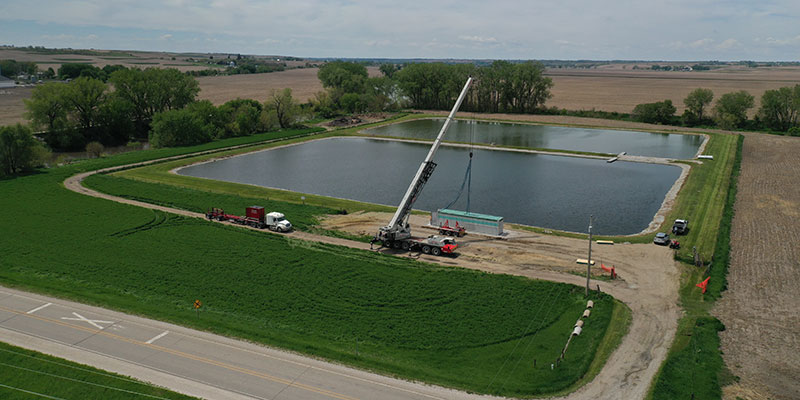
An MABR wastewater treatment system installed alongside an existing lagoon to help improve nitrogen removal and support compliance with stricter nutrient limits.
MABR and Aspiral™ are well suited for applications where customers need stronger nitrogen removal with a smaller footprint, lower energy consumption, and reduced construction burden.
Lagoon upgrades benefit from Aspiral™ because many now face tightening limits on ammonia, total nitrogen, or other nutrients for which they were not designed. Aspiral™ can help bring lagoon systems into compliance by adding modular MABR treatment capacity.
For example, Fluence has deployed MABR technology in municipal lagoon upgrade projects across the U.S. Midwest, helping communities meet increasingly stringent nutrient requirements without replacing existing lagoon infrastructure.
Aspiral™ can also support small and mid-size municipal systems, decentralized wastewater treatment, resorts and developments, industrial facilities, and phased capacity expansions with compact plants, lower aeration energy cost, simplified installation, and agile scalability.
Is Full Nitrogen Removal Always Necessary?
Some systems primarily need nitrification to convert ammonia into nitrate, which can help meet ammonia limits without removing total nitrogen. Other systems must meet broader total nitrogen limits. These applications require both nitrification and denitrification, allowing ammonia to be converted to nitrate and nitrate to be reduced to nitrogen gas. Fluence MABR supports both nitrification-denitrification and nitrification only.
The best treatment strategy depends on the permit, receiving water, reuse goal, site conditions, influent characteristics, and long-term compliance needs. A system designed solely for ammonia removal might not meet total nitrogen limits, while full nitrogen removal can add unnecessary cost if the permit requires only nitrification.
Financing and Operating Nitrogen Removal Upgrades
Nitrogen removal upgrades can strain capital budgets and operating teams, and some projects need to meet tighter limits faster than traditional infrastructure planning allows. Others need advanced treatment but lack the staff to operate and maintain a more complex system.
While Fluence supports conventional equipment delivery, Water Management Services also offers BOO, BOOT, and leasing options that provide water and wastewater treatment, reducing upfront capital requirements while transferring much of the operational responsibility to Fluence and maintaining comprehensive O&M.
Bringing Nitrogen Removal Within Reach
How can communities, businesses, and industry efficiently remove nitrogen in a way that fits the site, the budget, the operating team, and the long-term compliance strategy?
While no single nitrogen removal strategy fits every application, advances in technologies such as MABR are helping utilities and facilities meet increasingly stringent nutrient limits with lower energy consumption and a smaller footprint. Fluence's Aspiral™ Flex platform applies these principles in a modular format that can support new treatment facilities, phased expansions, and lagoon upgrades.
Contact Fluence to learn how Aspiral™ Flex can help meet your nitrogen removal and compliance goals.


