
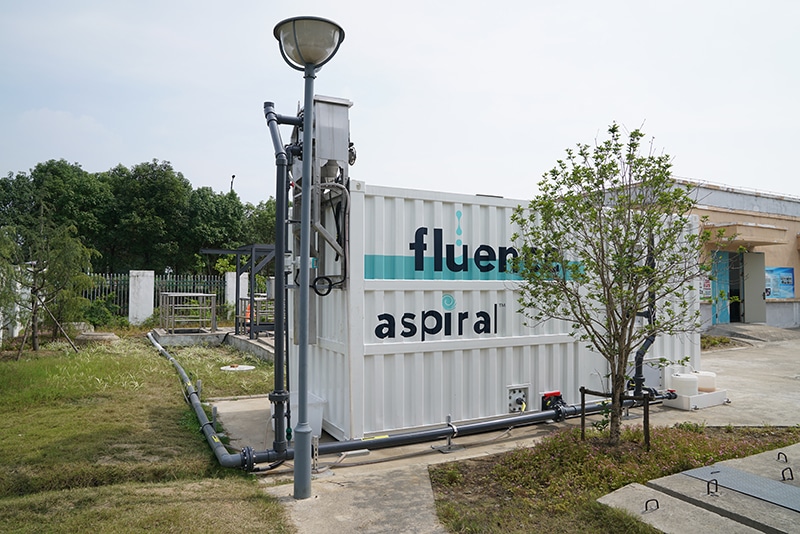
Containerized Aspiral™ Flex plants help communities expand wastewater treatment capacity without overbuilding too early.
Utilities face a tough challenge: building wastewater treatment systems that meet future demand without overspending today. Adding treatment modules as needed helps avoid overcommitting capital and carrying unused capacity.
Communities rarely grow in clean, predictable increments. A utility may plan for a wastewater treatment system with a capacity of 3 million GPD (11,356 m3/d) only to discover that the actual need remains far below that threshold for years. In a capital-intensive infrastructure environment, that mismatch matters. Committing to a large, one-time wastewater project is becoming harder to justify when utilities already face funding pressure, aging assets, and competing priorities.
When a community builds a full-capacity treatment plant too early, it locks up capital in assets that may sit, unneeded, for years. The opposite problem carries its own risks. If growth arrives faster than expected, underbuilt plants can face compliance pressure, costly emergency upgrades, and public frustration as capacity chases demand instead of staying ahead of it.
That tension has shaped wastewater planning for decades. Traditionally, communities have planned for future needs at the outset of a project despite uncertainty, but increasing climate volatility and shifting demand patterns have made that kind of long-range precision harder to sustain.
Phased Expansion in Practice
With phased expansion, rather than building for projected long-term demand upfront, a utility installs the capacity it needs today and designs the system so additional treatment can be added later in stages.
The concept is simple, but the operational impact is significant. Instead of relying on long-term forecasts, the plant’s growth is based on real population and flow data. Communities have room to respond to actual conditions, whether growth accelerates or slows.
This approach fits within a broader move toward right-sized and distributed infrastructure. Wastewater systems don’t always need to follow a one-size-fits-all centralized model, especially when timing, site constraints, and capital discipline matter. Flexible infrastructure can often be implemented faster, and it aligns more closely with present and future needs.
Why Containerized MABR Works for Phased Infrastructure
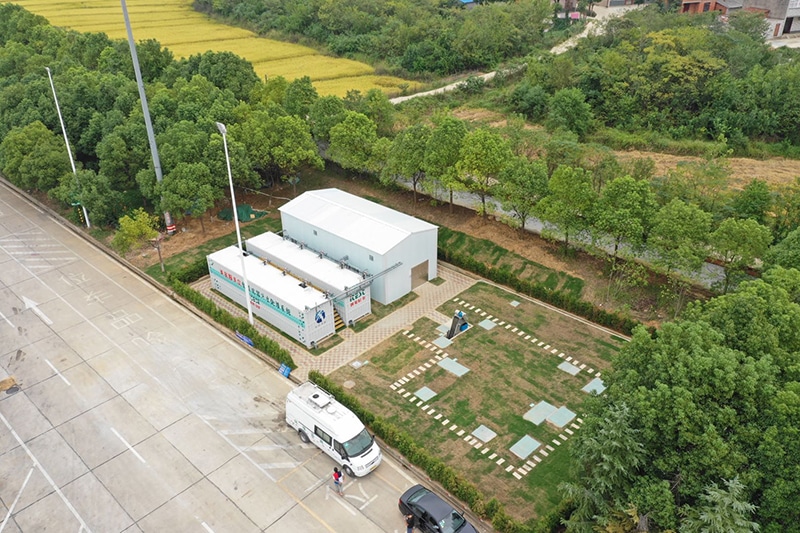
Fluence’s containerized Aspiral™ Flex system is designed for compact deployment, making phased wastewater expansion possible even in space-constrained or remote settings.
Advances in technology are making a phased approach to infrastructure increasingly practical. Fluence’s Aspiral™ Flex plants are designed for modular expansion and use membrane aerated biofilm reactor (MABR) technology to deliver compact, energy-efficient treatment. Fluence also offers other modular wastewater treatment solutions, depending on project needs.
Additional capacity can be added without a utility having to rebuild the whole plant from scratch. That matters both physically and operationally. Energy-efficient MABR systems enable compact upgrades that fit on constrained sites and can help communities improve existing assets. This flexibility can change the economics of expansion.
The combination of modular biological treatment and containerized deployment gives utilities a way to scale capacity without the disruption that often accompanies conventional plant expansion.
In urban and fast-growing areas, containerized and packaged systems can also support staged buildout where land, timing, or installation complexity would otherwise slow progress.
The Case for Adding Capacity in Stages
The strongest argument for phased modular expansion is not just technical. It’s strategic. When treatment capacity grows in controlled increments, communities reduce the long-term risk that comes with larger projects.
Capital commitments can track real demand more closely. The risk of stranded capacity falls. Commissioning becomes more manageable. Expansion can also create less disruption for the community and for the plant’s operations team because new modules integrate into an operating framework rather than forcing a wholesale reset.
That’s why the phased model is appealing in an era defined by uncertainty. Population shifts, industrial activity, tighter regulations, and uneven funding cycles all complicate wastewater planning. A system designed to expand when needed is better positioned to absorb those changes than one designed around a fixed forecast.
Planning for Variability, Not Just Volume
Wastewater infrastructure should be planned to remain viable under future variability, not just sized for today’s capacity needs. That means planning for changing growth patterns, site conditions, and financial realities without forcing communities into premature overbuilding.
Fluence’s experience in decentralized and modular treatment supports that kind of planning. Its MABR-based systems, including Aspiral™ Flex, are built for staged expansion, compact deployment, and lower-risk growth.
Just as importantly, Fluence can pair modular phasing with timeline-based leasing and also offers contracts for public and private customers through its Water Management Services. Under these agreements, Fluence finances, builds, and operates a plant at no upfront cost under a performance-based service agreement. This allows communities to align infrastructure delivery, operations, and spending more closely with real-world demand over time.
For utilities trying to reduce long-term exposure without losing room to grow, Fluence leasing and Water Management Services offer a practical path forward that aligns with modular, phased installation. Contact Fluence today to explore how phased wastewater expansion with MABR technology can optimize your capacity, reduce risk, and align infrastructure with real-world demand.


