
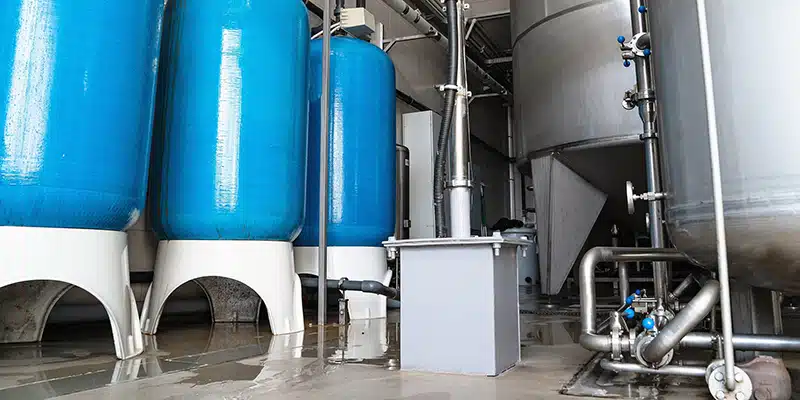
CEDI and ion exchange systems remove dissolved ions from water, helping industries achieve the high-purity and ultrapure water standards required for critical operations.
Comparing two common approaches to producing ultrapure water
Dissolved ions such as calcium, chloride, silica, and sodium can cause scaling and corrosion in industrial equipment, contaminate products during manufacturing, and cause performance instability in sensitive systems. As a result, many industrial processes, from semiconductor and microelectronics production to pharmaceuticals, power generation, AI infrastructure, and data center cooling systems, require a reliable supply of high-purity or ultrapure water to operate efficiently and consistently.
Several demineralization technologies can produce high-purity and ultrapure water. Two of the most common are conventional ion exchange and continuous electrodeionization (CEDI). While ion exchange remains a proven and widely used technology, many facilities are adopting CEDI to reduce chemical use, simplify operations, and improve process consistency.
What Are Ion Exchange and CEDI Systems?
Ion exchange is a chemical process in which undesirable dissolved ions are removed from water by exchanging them with more desirable ions using resin beds. Once the ions in the resin beds are depleted, they must be chemically regenerated with acids or caustic additives.
CEDI continuously regenerates its resins electrically, eliminating the need for acid and caustic regeneration chemicals. It uses ion exchange resins and membranes, along with an electric current, to continuously remove ions from water while regenerating the resins in place.
CEDI vs. Ion Exchange: Key Differences
The table below outlines the key differences between ion exchange systems and CEDI.
| Parameter | Ion Exchange | CEDI |
|---|---|---|
| Water quality | High purity (performance varies between regenerations) | Consistent ultra-high purity |
| Chemical use | Requires acid and caustic regenerants | No chemical regenerations |
| Regeneration | Periodic offline regeneration | Continuous self-regeneration |
| Maintenance | Higher operator involvement | Lower routine operator involvement |
| Operating costs | Higher chemical + maintenance costs | Lower operational costs |
| Capital costs | Lower initial capital cost | Higher initial CAPEX |
| Waste generation | Significant chemical waste | Minimal waste |
How Ion Exchange Demineralization Works
Ion exchange systems consist of a bed of resin beads that attract and hold ions. Two types of resins are used in this process: one targets cations such as calcium, magnesium, and sodium, exchanging them for hydrogen (H+), while the other targets anions such as carbonate, chloride, and sulfate, exchanging them for hydroxide (OH-). The H+ and OH- ions combine to form a water molecule (H2O).
During this process, the resin bed becomes saturated with contaminants. Once exhausted, the system must be shut down so the resin beds can be regenerated using acid and caustic chemicals. Acid is used to restore cation resins, and caustic is used to restore anion resins.
Because the resin beds must periodically be taken offline for regeneration, conventional ion exchange systems operate in cycles rather than continuously.
How CEDI Demineralization Works
CEDI systems combine ion exchange resins with ion-selective membranes and an electric field. The electric field continuously removes dissolved ions from the product water and transports them through the membranes into a separate concentrate stream.
The electrical current also splits water molecules (H₂O) into hydrogen (H+) and hydroxide (OH-) ions. These ions continuously regenerate the ion exchange resins in place, eliminating the need for chemical regeneration.
The result is a process that produces consistently high-purity water without interruption.
Why Isn’t CEDI Used Directly on Raw Water?
Because CEDI relies on electrical regeneration, it is typically installed downstream of reverse osmosis (RO). RO removes the majority of dissolved salts and other contaminants, allowing CEDI to efficiently polish the remaining ions to achieve ultrapure water quality. Using CEDI without adequate pretreatment can reduce performance, increase scaling and fouling, and shorten the life of the system. For this reason, most industrial ultrapure water systems combine RO and CEDI as complementary technologies.
When Ion Exchange Might Be the Better Choice
Despite the advantages of CEDI, ion exchange might be a better option in some scenarios.
- Existing infrastructure: Facilities already built around ion exchange systems might not justify the expense of upgrading to CEDI.
- Smaller systems: Ion exchange might be a better choice for low-flow applications that do not warrant the higher upfront cost of CEDI systems.
- Lower capital budgets: Ion exchange systems are ideal for facilities where limited upfront capital is the primary constraint.
- Less-demanding purity requirements: Ion exchange is well suited for applications where ultra-high-purity water is not required.
In these cases, ion exchange remains a proven, cost-effective solution.
When CEDI Might Be the Better Choice
When consistency, automation, and sustainability are key priorities, CEDI is a strong fit:
- Continuous operations that cannot tolerate downtime
- Ultrapure water applications with stringent conductivity requirements
- Semiconductor manufacturing where trace ions can affect yields
- Power generation facilities that require consistent ultrapure boiler feedwater and steam-cycle makeup water
- Electronics production that requires ultrapure rinse water
- Pharmaceutical facilities where water quality directly affects product quality and regulatory compliance
- Sustainability initiatives focused on reducing chemical consumption and waste generation
In these environments, the benefits of operational stability, consistent water quality, and reduced chemical handling often outweigh the higher upfront capital costs.
Many Ultrapure Water Systems Pair Reverse Osmosis with CEDI
In modern high-purity water trains, CEDI is often paired with RO in an integrated system approach. Fluence has extensive experience designing and integrating RO-CEDI treatment trains for industries that depend on consistently ultrapure water.
By combining advanced RO pretreatment with CEDI polishing, Fluence helps facilities achieve stringent water quality requirements while reducing chemical consumption, operator involvement, and maintenance demands. Our team works closely with clients to optimize system performance, reliability, and lifecycle costs, delivering customized solutions that support critical manufacturing and process applications.
Case Study: Ultrapure Water for Power Generation
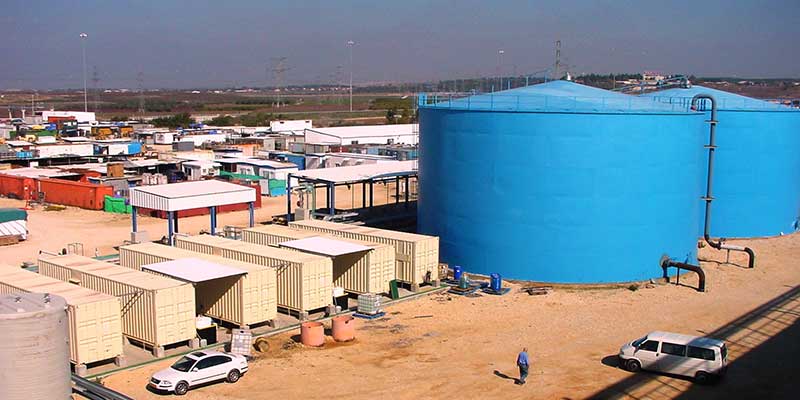
Containerized RO-CEDI systems helped Israel Electric Company produce ultrapure water for combined-cycle power generation while reducing chemical use and minimizing footprint requirements.
Fluence has implemented RO-CEDI treatment trains in demanding industrial environments. For example, when the Israel Electric Company upgraded several power plants from open-cycle turbines to combined-cycle generation, it required significantly more ultrapure water for steam generation and NOx emissions control. The utility had previously relied on traditional ion exchange technology but needed a solution capable of producing larger volumes of ultrapure water within a limited footprint.
Fluence designed and supplied containerized treatment systems that combined RO, gas-transfer membrane (GTM) degassing, and CEDI technologies. The GTM degassing process removed dissolved carbon dioxide before CEDI, improving overall system efficiency and reducing electrical demand. More than 15 production modules were deployed across seven power plants, providing consistent ultrapure water quality while reducing chemical consumption and minimizing space requirements. The systems continue to meet stringent water-quality specifications while supporting reliable power plant operations.
Looking Beyond Capital Costs: Total Cost of Ownership
While CEDI systems typically involve a higher upfront capital investment, facilities should evaluate the total cost of ownership rather than CAPEX alone. Conventional ion exchange systems often incur ongoing expenses related to regeneration chemicals, labor, maintenance, downtime, and waste disposal. By eliminating chemical regeneration and operating continuously, CEDI can significantly reduce these costs, making it an attractive long-term option for facilities focused on operational efficiency.
Choosing between ion exchange and CEDI depends on factors such as water quality requirements, operating costs, staffing resources, environmental objectives, and process reliability.
Fluence has extensive experience designing demineralization systems for a wide range of applications. Contact our team to discuss your ultrapure water needs and to learn more about the technologies and solutions we offer.


