
High-rate anaerobic treatment is particularly useful in industries that produce a low mass, high-COD effluent, like alcohol production and dairy processing.
For industries that produce an effluent with high organic load but low mass, high-rate anaerobic systems offer a compact, efficient solution
Industrial wastewater treatment is rarely a one-size-fits-all challenge. As wastewater strength increases, conventional treatment approaches can become inefficient, energy intensive, and difficult to operate reliably. For many industrial facilities — particularly in the food and beverage sector — high-rate anaerobic treatment offers a more stable and cost-effective solution. This is where advanced system design becomes especially important.
At Fluence, high-rate anaerobic systems are used not simply to generate biogas, but to optimize industrial pretreatment processes, reduce operating costs, and improve compliance performance. Among these technologies, Fluence's externally forced circulation (EFC) process introduces several design advantages that improve operational stability and biomass retention.
The Shift from Traditional Digestion to Industrial Pretreatment
To understand why these systems are so effective, it helps to look at how industrial applications differ from traditional anaerobic use cases.
Anaerobic digestion is often associated with high-solids sludge treatment, where the primary objectives are sludge stabilization, volume reduction, and maximum biogas production. These systems are commonly used at municipal facilities or agricultural operations where solids handling is the central focus.
Industrial wastewater applications are different.
In many food and beverage facilities, the wastewater contains relatively low concentrations of solids but very high levels of dissolved organic material. Instead of maximizing biogas production, the primary goal becomes reliable pretreatment before discharge to a local publicly owned treatment works (POTW). These facilities focus on maintaining compliance, minimizing surcharges, reducing operating costs, and ensuring stable plant operations.
This distinction significantly changes the role of the anaerobic system. Rather than functioning as a solids management process, the digester becomes a critical component of wastewater process optimization.
These differences also help explain why conventional aerobic treatment often struggles in high-strength industrial applications.
Why Aerobic Treatment Reaches Its Limits
As with anaerobic treatment, conventional aerobic treatment systems perform well at moderate organic loading rates, but as wastewater strength increases, several physical and operational limitations begin to emerge.
Higher organic concentrations require substantially more oxygen transfer, which increases blower energy demand and aeration requirements. As aeration rates climb, oxygen transfer efficiency (OTE) often declines due to bubble coalescence, reduced contact time, and mixing limitations. Facilities may then require larger basins, longer hydraulic retention times (HRTs), and larger equipment to maintain performance.
At the same time, higher food-to-microorganism ratios lead to increased sludge production, further increasing disposal and handling costs.
Eventually, many facilities reach a point where aerobic treatment is no longer technically or economically practical. This is typically where high-rate anaerobic pretreatment becomes attractive.
In many industrial applications, that transition begins with a chemical oxygen demand (COD) of about 3,000 to 4,000 mg/L, depending on wastewater composition and plant objectives.
Understanding High-Rate Anaerobic Digestion
At this point, high-rate anaerobic systems become a compelling alternative.
High-rate anaerobic systems are designed to treat strong industrial wastewater with very short retention times while maintaining high organic removal efficiency.
A key feature of these systems is the development of dense granular biomass. Unlike conventional suspended floc systems, anaerobic granules have exceptional settling properties, allowing the biomass to remain inside the reactor even under high hydraulic loading conditions.
Because anaerobic systems are not limited by aeration capacity, they can maintain extremely high biomass concentrations, often exceeding 60 g/L mixed liquor volatile suspended solids (MLVSS). This enables significantly shorter HRTs while still achieving strong COD reduction performance.
Another important advantage is the decoupling of solids retention time (SRT) from hydraulic retention time. Since the biomass is retained within the reactor, microorganisms can remain active for long periods even as wastewater moves rapidly through the system.
The result is a compact, energy-efficient treatment process capable of handling very high organic loading rates.
Why Granular Biomass Matters
Granular anaerobic biomass is central to the success of high-rate digestion systems.
These granules are dense, compact microbial structures typically ranging from 0.5 to 3 mm in diameter. Their excellent settling characteristics prevent biomass washout and allow reactors to operate at very high loading rates.
The layered structure of the granule also creates an ideal microbial environment. Faster-growing organisms tend to occupy the outer layers, while slower-growing methanogenic organisms develop within the protected inner core. This microbial stratification helps maintain stable biological performance even under changing operating conditions.
Granule size and density also play an important role in reactor hydrodynamics. High-rate systems use controlled upflow velocities to create a fluidized bed where wastewater and biomass remain in constant contact. Lighter granules are pushed upward or removed, while denser and more mature granules remain within the reactor.
This hydraulic selection process improves long-term biomass quality and reactor performance.
The Importance of Reactor Hydrodynamics
In high-rate anaerobic systems, hydrodynamics are just as important as biology.
These reactors rely on carefully controlled upward liquid velocities to expand the granular bed without washing out biomass. Proper mixing improves mass transfer between wastewater and microorganisms while maintaining granule retention.
During startup and acclimation, operators may adjust upflow velocities to support granule development and stabilize the microbial population.
Maintaining this balance is critical. Poor mixing can lead to biomass stratification, reduced treatment efficiency, and unstable reactor operation.
How Fluence's EFC Process Differs
Building on these hydraulic considerations, system design plays a key role in overall performance.
Fluence's EFC technology introduces several design features intended to improve process stability and operational control.
Many conventional high-rate anaerobic systems rely on internally generated biogas for reactor mixing. While this approach can reduce mechanical equipment requirements, it also means mixing intensity fluctuates with biogas production. Changes in organic loading can therefore create inconsistent mixing conditions inside the reactor.
This variability can disrupt granule separation and lead to unstable bed expansion, reducing overall reactor performance.
As the name "externally forced circulation" indicates, the EFC process separates mixing from biogas generation by using controllable external liquid recirculation. This allows operators to maintain stable and predictable reactor velocities regardless of fluctuations in gas production.
The diagram below illustrates how Fluence’s EFC process maintains stable mixing and biomass retention independently of biogas production.
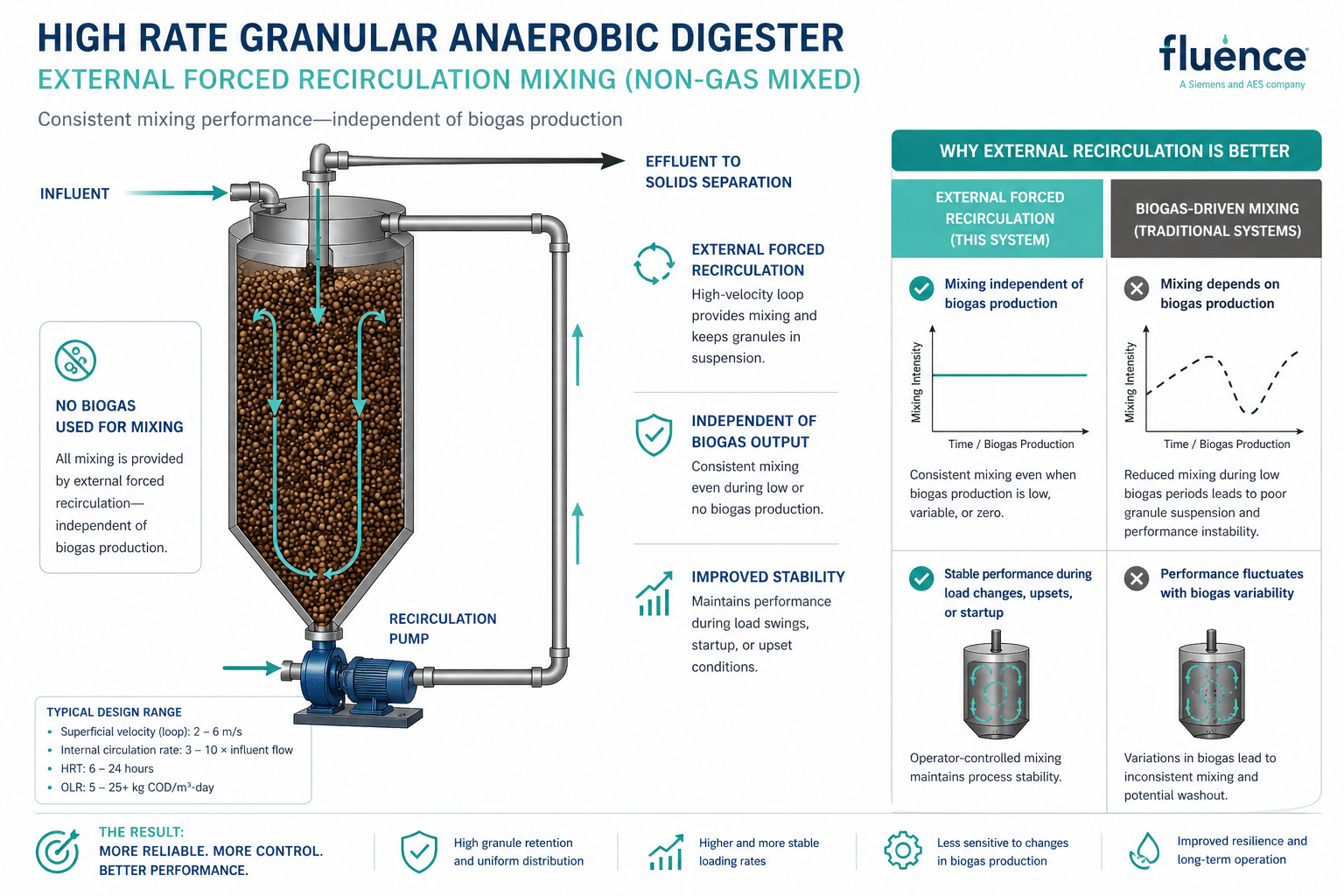
By decoupling mixing from biogas output, the EFC process improves:
- Granule retention
- Bed expansion control
- Hydraulic stability
- Process predictability
- Overall treatment reliability
The result is a more stable and controllable high-rate anaerobic process.
Eliminating the Need for Pre-Acidification
Another key feature of the EFC process is the ability to treat many industrial wastewaters without a separate pre-acidification stage.
In some anaerobic systems, pre-acidification is used to convert soluble COD into volatile fatty acids (VFAs) before methanogenic treatment. However, for many food and beverage wastewaters dominated by dissolved organics, this additional step can actually reduce process stability.
Excessive acidification may disrupt the natural microbial balance within the granular biomass and inhibit downstream methanogenic activity. It can also produce low-quality off-gas with insufficient methane concentration for efficient energy recovery.
By sending wastewater directly to the granular EFC reactor, facilities can achieve:
- Higher methane yield
- Improved pH and alkalinity stability
- Lower capital cost
- Simplified operations
- Reduced process complexity
For many food and beverage applications, direct treatment improves both operational performance and overall biogas utilization.
Secondary Solids Separation and Biomass Retention
The EFC process also incorporates an external solids separation stage designed to improve long-term biomass retention.
Even in well-operated systems, some fine granules may occasionally escape the reactor. The secondary capture unit recovers these particles and recirculates them back into the process, allowing continued granule development and preventing biomass inventory loss.
This additional retention step helps:
- Maintain stable biomass concentrations
- Increase solids retention efficiency
- Support higher organic loading rates
- Improve resilience to hydraulic spikes
- Reduce seeding requirements
- Lower suspended solids in final effluent
Consistent biomass retention is one of the key factors enabling stable long-term operation in high-rate anaerobic systems.
Where High-Rate Anaerobic Systems Excel
High-rate anaerobic pretreatment systems are particularly effective for industries with high soluble COD and relatively low solids content.
Common applications include:
- Alcohol production
- Dairy processing
- Soft drink and juice manufacturing
- Fermentation and biotechnology facilities
- Sugar and starch processing
- Certain pulp and paper operations
- Food ingredient manufacturing
These systems are especially valuable where facilities require compact treatment footprints, low operating costs, and reliable compliance.
Many EFC installations around the world have operated successfully for more than a decade while maintaining high COD removal efficiency and minimal footprint requirements.
A Practical Solution for High-Strength Industrial Wastewater
As industrial wastewater becomes more concentrated, conventional aerobic treatment can quickly become energy-intensive and operationally challenging. High-rate anaerobic systems offer an alternative that reduces energy demand, minimizes sludge production, and improves process stability.
Fluence's EFC technology builds on these advantages by incorporating externally controlled mixing, eliminating unnecessary pre-acidification, and enhancing biomass retention strategies.
For facilities facing rising wastewater strength, energy costs, or pretreatment surcharges, high-rate anaerobic systems can provide a more compact and energy-efficient path to compliance. Contact Fluence to learn more about how your business can benefit.
High-Rate Anaerobic Wastewater Treatment FAQ
What industries benefit most from high-rate anaerobic treatment?
High-rate anaerobic treatment is most effective in industries that generate wastewater with high concentrations of dissolved organic material and relatively low solids content. Common applications include dairy processing, alcohol production, beverage manufacturing, food ingredient processing, fermentation facilities, sugar and starch production, and certain pulp and paper operations. These industries often produce high COD wastewater that can make conventional aerobic treatment energy-intensive and costly to operate.
What is the difference between aerobic and anaerobic wastewater treatment?
Aerobic wastewater treatment relies on oxygen to support biological activity, which requires significant blower energy and aeration infrastructure. Anaerobic treatment operates without oxygen and uses specialized microorganisms to break down organic material in high-strength wastewater. Because anaerobic systems do not require continuous aeration, they typically consume less energy and produce less sludge than aerobic systems, particularly in industrial pretreatment applications with high organic loading rates.
When does anaerobic pretreatment become cost-effective?
Anaerobic pretreatment often becomes economically attractive when wastewater COD concentrations reach approximately 3,000 to 4,000 mg/L, although the exact threshold depends on wastewater composition, discharge requirements, and facility goals. At higher organic loading rates, aerobic systems may require larger basins, greater aeration energy, and increased sludge-handling capacity, making high-rate anaerobic systems a more compact and energy-efficient alternative.


