
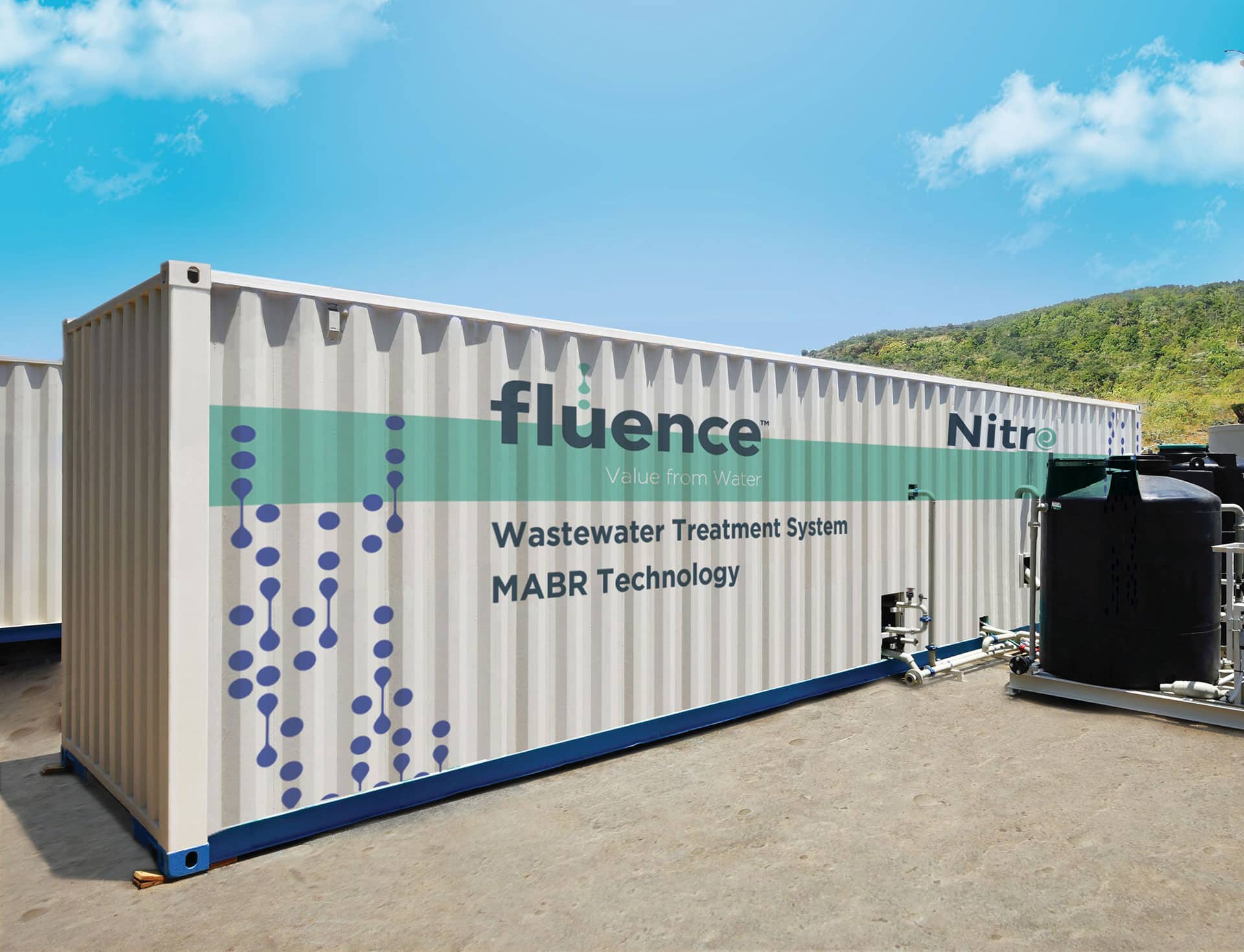
Containerized MABR systems provide municipalities with a compact, energy-efficient solution for meeting nutrient limits and supporting phased growth.
How membrane aerated biofilm reactors support small communities, plant upgrades, and decentralized wastewater treatment
Municipal wastewater utilities today are under increasing pressure to do more with less. Stricter nutrient discharge limits, expensive chemicals, aging infrastructure, landlocked areas, rising energy costs, and growing populations all demand treatment solutions that are efficient, flexible, and future-ready. Membrane Aerated Biofilm Reactor (MABR) technology addresses these challenges, offering a modern biological treatment approach that fits many municipal applications.
Rather than replacing traditional treatment, MABR enhances and extends what municipalities can achieve. It improves performance, reduces operational costs, and supports sustainable water management.
While MABR technology is often introduced through its underlying biology and aeration principles, this article focuses specifically on how municipalities apply MABR in real-world wastewater treatment systems—from small communities to large-scale plant upgrades.
How MABR Functions in Municipal Treatment Systems
At its core, MABR combines membrane technology with biological treatment in a highly efficient way. Oxygen is delivered through gas-permeable membranes to microorganisms growing as a biofilm on the membrane surface. This passive diffusion allows oxygen molecules to reach the bacteria without the turbulence and energy losses associated with conventional diffused aeration systems.
Because oxygen is supplied from within the membrane and wastewater flows outside, MABR enables simultaneous nitrification and denitrification within a single treatment step. This means nitrogen removal can occur continuously and more efficiently, in a smaller footprint, and with significantly lower energy demand.
For municipalities facing rising power costs or sustainability mandates, this energy efficiency is a major advantage.
MABR Is Well-Suited for Municipal Systems

Fluence offers MABR treatment in both containerized Aspiral™ plants and as SUBRE towers that can be used to upgrade existing wastewater treatment plants or in greenfield installations.
Municipal wastewater treatment systems are rarely static. Flows fluctuate seasonally, development expands service areas, and regulatory requirements evolve. MABR technology is designed with this in mind.
Key advantages include:
- High oxygen transfer efficiency, reducing blower energy requirements
- Compact footprint, ideal for constrained sites
- Containerized design, enabling phased expansion
- Low noise and odor, supporting community acceptance
- Operational simplicity, reducing staff burden
These characteristics allow MABR systems to integrate smoothly into both centralized and decentralized municipal treatment strategies.
Municipal Applications Where MABR Excels
- Plant upgrades and retrofits
Many wastewater treatment plants struggle to meet new nutrient limits without costly expansions. MABR towers can be installed within existing aeration basins or treatment trains, boosting nitrogen removal (and enhancing phosphorus removal) capacity without expanding plant footprints or disrupting operations. - Small and medium community treatment plants
For towns and municipalities without access to large, centralized facilities, MABR wastewater treatment plants provide a reliable and scalable solution. Containerized and modular systems can be deployed quickly, reducing capital costs and construction timelines and delivering high-quality effluent. - Decentralized developments
New residential developments, satellite communities, schools, and mixed-use projects increasingly rely on decentralized treatment. MABR systems offer a way to support growth and avoid expensive sewer extensions while maintaining consistent treatment performance. - Water reuse and resource recovery
As water reuse becomes more common, MABR helps municipalities produce high-quality treated effluent suitable for irrigation, landscaping, and other nonpotable reuse. Improved nitrogen removal also protects downstream ecosystems and supports sustainability goals.
Supporting Long-Term Municipal Resilience
Beyond treatment performance, MABR contributes to broader municipal resilience. Lower energy consumption reduces vulnerability to rising utility costs. Modular scalability avoids overbuilding. And improved effluent quality helps utilities stay ahead of regulatory changes.
By adopting MABR, municipalities gain a treatment platform that adapts as community needs evolve, supporting reliable wastewater management today and preparing for tomorrow’s challenges.
Contact Fluence to discuss how MABR can be applied to your municipal wastewater system, whether you’re upgrading an existing plant or planning for future growth.


