
Municipalities are beginning to evaluate projects not only on cost, but also on delivery speed and the risk exposure tied to long schedules. Fast deployment is becoming a core part of the compliance strategy.
Delays can add costs or cancel projects in 2026
Communities entered 2025 with tight timelines, rising regulatory pressure, and mounting infrastructure needs, and many saw time turn into their most unpredictable and costly variable.
Long, unpredictable permit windows added months or years to schedules. Federal infrastructure reports have long shown that delays can stall or even cancel critical projects. Even when funding was available, demand outpaced key federal loan programs, and bureaucratic cycles pushed construction openings further into the future, driving up costs and extending backlogs.
Missed deadlines created consequences that many municipalities didn’t anticipate. Housing production slowed where sewer capacity could not keep up, halting projects and constraining local economic development. In some regions, lots sat idle because essential infrastructure like water and sewer systems was not in place, keeping entire communities in limbo despite high demand for growth.
The trend across 2025 was consistent. Municipalities that stayed with traditional, stick-built approaches saw overruns stack up and their margin for error shrink. The communities that stayed ahead of need were those that recognized timing as a strategic risk factor and chose water treatment solutions that could be delivered on schedule.
Traditional Infrastructure Timelines Are Untenable
Across the country, 2025 made it clear that conventional water and wastewater projects move too slowly for the pressures that communities face. Traditional plants require years of planning, bidding and construction, which leaves municipalities exposed when deadlines tighten or growth accelerates unexpectedly. These extended timelines rely on large footprints, specialty labor, and custom engineering, each adding potential points of delay.
At the same time, new regulatory requirements, including binding PFAS monitoring and treatment deadlines, cut the time that utilities once had to wait for long capital cycles. Competitive regions and industries are accelerating their service expectations, and years-long project schedules no longer align with the realities of compliance or economic development.
These pressures pushed many communities to reevaluate not only what type of infrastructure they build, but how they build it.
Containerized, Plug-and-Play Treatment
As delays mount, many communities turned to containerized, plug-and-play solutions that compress delivery schedules and reduce construction risk. In water infrastructure, plug-and-play means factory-built, pretested systems delivered in containerized modules that arrive ready to install.
These systems offer accelerated deployment, measured in weeks instead of years, as well as predictable costs and timelines, smaller footprints, and modular scalability that allows capacity to grow as quickly as demand. In one case in rural China, Fluence installed and commissioned a modular plant inside a ten-day window.
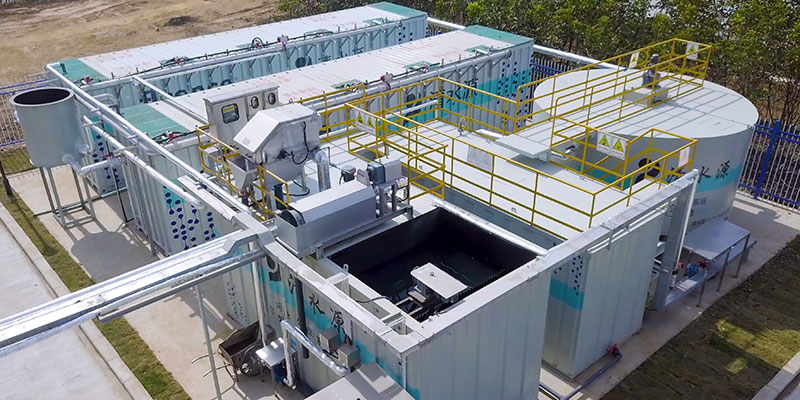
Fluence’s packaged, containerized systems streamline installation by arriving pretested and ready to connect, reducing on-site construction time and risk.
Fluence’s NIROBOX™ units provide compact, pre-engineered desalination and potable water treatment that can be rapidly commissioned on constrained sites.
For wastewater and other applications, Aspiral™ Flex represents the newest evolution of Fluence containerized treatment solutions. Flex units are decentralized, factory-tested systems that house every phase of treatment within modular units, removing the need for external tanks, clarifiers, and most on-site assembly. This approach simplifies installation and reduces overall project costs.
Flex Blocks can be configured to address a wide range of treatment needs, including MABR, CAS, MBR, secondary clarification, disinfection, UF, MF, and NF. Options for equalization, tertiary treatment, and polishing can also be added based on site-specific requirements. The logistical advantages of plug-and-play modular plants are recognized in time-sensitive sectors such as data centers, where companies must meet aggressive launch windows.
With faster, scalable options now available, many municipalities are reframing the question from “What will this plant cost?” to “How quickly can we secure compliance and capacity?”
Rethink Risk for 2026: Speed Is a Compliance Strategy
Municipalities are beginning to evaluate projects not only on cost, but on delivery speed and the risk exposure tied to long schedules. Fast deployment is becoming a core part of compliance strategy. Incorporating modular, rapid-deploy systems into capital planning helps communities secure capacity ahead of need and avoid delays.
Financing models such as BOO, leasing, and other performance-based service agreements further shorten timelines and shift risk to the provider. Under Fluence’s Water Management Services agreements, for instance, construction and delivery accountability shifts to Fluence, enabling faster, more predictable outcomes. With firm PFAS deadlines approaching, the cost of waiting has grown too high, and speed itself has become a protective measure for utilities balancing compliance with community expectations.
Building Momentum with Faster Infrastructure
The lessons from 2025 point to a new reality for communities planning water and wastewater upgrades. Delivery speed is central to managing regulatory obligations, economic development, and growth. Municipalities that build flexibility into their capital plans, adopt decentralized treatment systems, and rely on performance-based service agreements such as Fluence Water Management Services, can respond quickly when conditions change.
As 2026 approaches, contact Fluence to get ahead of demand and stay there with scalable, factory-built systems engineered to deliver reliable infrastructure fast.


