
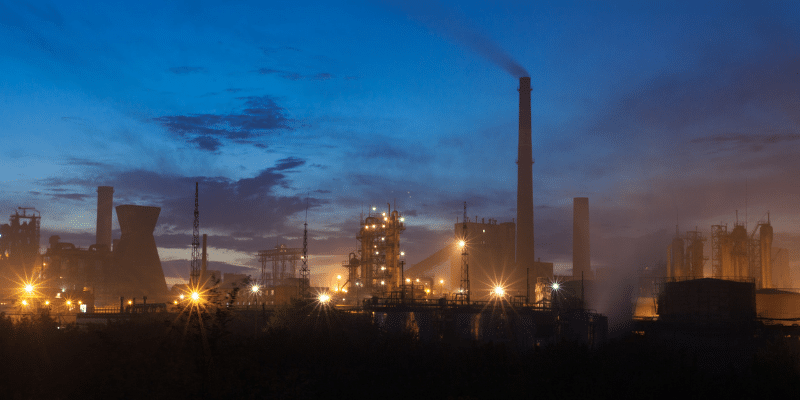
Because of water supply challenges, more facilities are redefining the industrial water cycle as a closed or near-closed system.
A comprehensive guide to sourcing, treating, reusing, and recovering water across industrial operations
Industrial water management is under more pressure than ever. Water-stressed regions, rising production demands, and tighter regulations are forcing plants to rethink how they source, treat, and discharge water. Instead of treating water as a one-way resource that comes in, gets used, and goes out, more facilities are beginning to design systems that intentionally close the loop, minimizing intake, maximizing water reuse, and treating wastewater as a resource rather than a burden.
This approach requires a clear understanding of the industrial water footprint. Every product has a hidden water cost, measured not just in what ends up in the final product, but in everything that supports it: cooling, heating, washing, steam generation, ingredient water, and sanitation.
While most consumers never think about exactly how much water sits behind a bottle, a kilowatt, or a processed protein, factories certainly do. They know exactly how much water is being withdrawn, how much is being lost, and what the risks are if those sources become constrained.
Understanding this footprint is especially important because global studies have shown that many economically active regions already are experiencing moderate to severe water stress, with withdrawals from rivers, lakes, and aquifers approaching or exceeding sustainable limits. In the United States, self-supplied withdrawals from surface and groundwater highlight clusters of extremely high use in manufacturing and energy corridors. Combined with growing populations and industrial expansion, this creates a clear challenge: If water use continues on a linear path, constraints on growth and reliability are inevitable.
Redefining the Industrial Water Cycle
Because of these challenges, more and more facilities are redefining the industrial water cycle as a closed or near-closed system. A typical plant may receive water from public utilities, wells, or surface water, or in some cases, from desalinated seawater or brackish water.
Some advanced sites have already added a fifth source, that is, their own treated effluent, designed to be cycled back into the process. Regardless of the source, raw water almost always requires conditioning. To protect equipment and meet process specifications, it’s necessary to manage dissolved solids, hardness, iron and manganese, turbidity, and microbiological concerns.
High-purity process water is often produced through a sequence of membrane and polishing technologies. Ultrafiltration and microfiltration are frequently used as first steps in the removal of suspended solids and pathogens to create a stable feed for downstream treatment. Where partial softening or color removal is needed but ultrapure water is not, nanofiltration can selectively remove divalent ions such as calcium and magnesium while allowing most monovalent ions to pass.
In more demanding applications, reverse osmosis is a workhorse, capable of removing the majority of dissolved salts and contaminants, and achieving up to 99% rejection of many ions.
For industries that require extremely low dissolved solids — such as certain power, electronics, or specialty manufacturing applications — reverse osmosis is often followed by electrodeionization (EDI) or conventional resin-based ion exchange. EDI uses ion exchange resins in a module powered by an electric field, continuously regenerating the resin in place without the need to handle strong acids and caustics on-site.
In other situations, separate cation and anion exchangers with a mixed-bed polisher can push water quality into the nanogram-per-liter range, meeting ultrapure specifications. In these cases, facilities must also consider how to manage regenerant streams and are increasingly interested in recovering rather than simply neutralizing and disposing of spent chemicals.
Closing the Loop on Industrial Wastewater
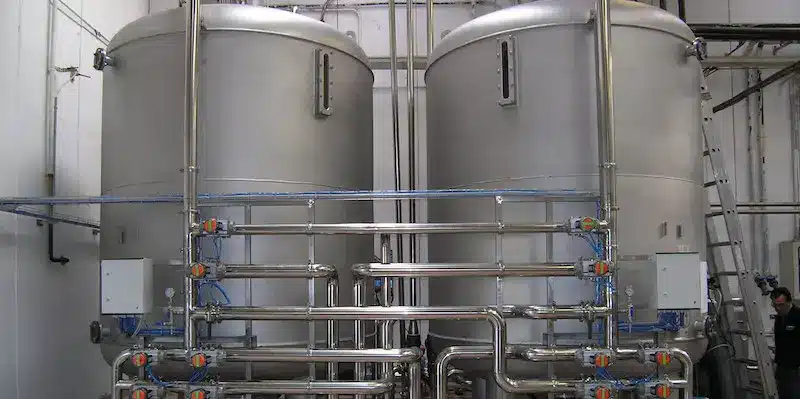
Adsorbent-resin columns used in beverage processing illustrate how targeted treatment steps support resource recovery and loop closure.
While process water treatment is what keeps production running, the back end of the plant — wastewater — is where closing the loop really becomes visible. Most industrial facilities generate wastewater from cleaning and sanitation systems, sanitary flows, and process discharges. The facility often conducts some form of pretreatment before water can leave the site, for example, the use of equalization tanks to buffer variable flows, screening and grit removal, chemical adjustment of pH, and in some cases targeted removal of metal, or fat, oil, and grease.
After pretreatment, biological treatment is usually the heart of the system. Conventional activated sludge, advanced nutrient removal processes, and membrane bioreactors are used to reduce organic load, nitrogen, and phosphorus to meet discharge permits.
Primary and secondary clarification, dissolved air flotation, or membrane separation then provide liquid-solid separation. When a facility is discharging to a sewer or to surface water, this may be enough. However, once water reuse becomes a goal, the stability and performance of secondary treatment become even more critical, because any remaining organics, solids, or nutrients can heavily influence the cost and reliability of advanced polishing.
Uses of Treated Effluent
After these processes, treated effluent can be directed in several ways. In some settings, irrigation and nonpotable reuse are the most straightforward options. Quality requirements vary by jurisdiction and application, but they generally include elevated standards for pathogen reduction, suspended solids, and often nutrients and metals. Tertiary filtration and disinfection — frequently ultrafiltration combined with ultraviolet disinfection — can elevate secondary effluent to a quality suitable for irrigating crops, landscaping, golf courses, or serving as certain wash waters or cooling tower makeup.
Beyond that, more advanced reuse options are increasingly being considered, including aquifer or surface water recharge, indirect potable reuse, direct potable reuse, and even the return of treated water directly into the production process itself.
As the level of reuse rises, the treatment focus shifts from the removal of just solids and pathogens to include dissolved salts, conductivity, disinfection byproducts, micropollutants, and trace organics. The same technologies used on the intake side — microfiltration, ultrafiltration, reverse osmosis, ion exchange, and advanced disinfection — are now applied to wastewater-derived feed. In effect, the industrial water and wastewater trains meet in the middle, using a common toolbox to support both intake reduction and reuse.
Full-Cycle Approach in Action
Several recent projects illustrate how this full-cycle approach works in practice.
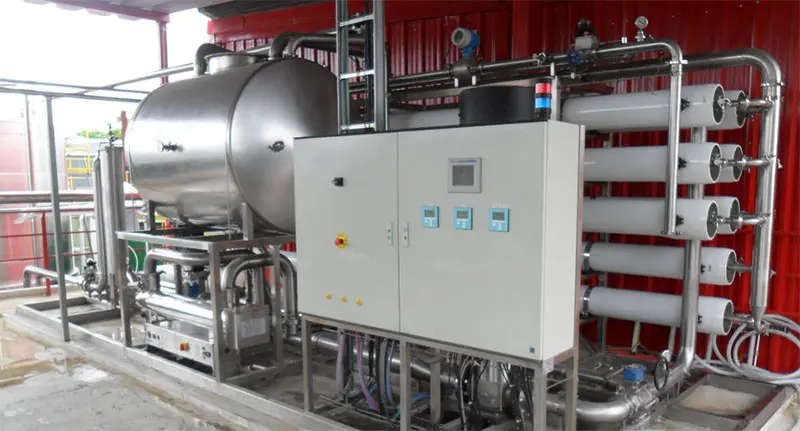
A multi-stage treatment train — including ultrafiltration, ion exchange, and reverse osmosis — supports high-purity water production in beverage processing.
- At a beverage manufacturing plant producing branded soft drinks, the raw water source had elevated boron and conductivity challenges that could not be ignored, given the sector’s stringent process water standards. The solution combined a specialty ion exchange resin specifically targeted at boron removal with a train of ultrafiltration for particulate and pathogen reduction, followed by reverse osmosis, granular activated carbon, and ultraviolet disinfection. The system was designed to produce just under 500,000 GPD (1,900 m3/d) of high-purity water, and a dedicated neutralization system was added to safely handle ion exchange regeneration waste. This combination delivered both reliable product quality and responsible management of concentrated waste streams.
- At a biomass power plant, a different challenge emerged: Two separate wells produced water with distinct qualities, and two uses within the process required different finished water specifications. A flexible, skid-mounted treatment system was implemented, beginning with ultrafiltration as a shared pretreatment step, then reverse osmosis for dissolved solids removal. Most of the permeate was directed to cooling towers, while a smaller portion was routed through a second-pass reverse osmosis system and finally through EDI to meet the tighter requirements for boiler makeup. The modular layout allowed the plant to balance water quality and quantity between processes without overbuilding a single monolithic treatment line.
- A combined cycle power plant facing limited local water availability took loop closure a step further. In addition to well water, the design team looked at recycled cooling tower blowdown as a supplementary source. A dedicated ultrafiltration system treated the blowdown so it could be blended with well water, which then passed through media filtration and reverse osmosis to reduce high chloride levels. Most of the permeate supported cooling needs, while a side stream was treated with second-pass reverse osmosis and EDI for boiler feed. The result was a system that reduced dependence on fresh withdrawals by turning a waste stream into a reliable part of the supply, all within tight spatial constraints that required stacking reverse osmosis skids vertically.
On the wastewater side, reuse is also being implemented at scale.
- At a large meat and protein processing facility, an expansion plan threatened to overwhelm the available municipal water supply infrastructure. Rather than simply reducing ambitions, the company partnered on a strategy to build a dedicated reuse plant at the site. Existing processes already included primary clarification, biological treatment, and digestion of sludge from both biological and flotation stages. To enable reuse, treated effluent was then fed to a microfiltration system using chemically resistant PVDF membranes, followed by ultraviolet disinfection. This created a high-quality effluent stream with a reuse capacity approaching 1 million GPD (3,785 m3/d), substantially reducing the factory’s net draw on municipal water while supporting its growth.
- In another case, a fish processing facility that used evaporation to dry and recover oils and proteins faced a different kind of constraint. The main wastewater stream was evaporation condensate with extremely high organic nitrogen and phosphorus, with chemical oxygen demand values around 8,000 mg/L and total nitrogen near 300 mg/L. Local access to fresh water was limited and costly, and the saline water that was trucked in caused boiler issues. The wastewater solution centered on a split-feed denitrification-nitrification process within a membrane bioreactor. This configuration reduced the internal nitrate recycle rate and associated energy consumption, while the membrane bioreactor provided the high-quality effluent needed for direct reverse osmosis feed. The resulting RO permeate was then used as boiler makeup, resolving salinity concerns, improving boiler performance, and turning a complex wastewater stream into a dependable internal resource.
Alongside these core water and reuse solutions, plants are also exploring more advanced options, including nutrient recovery and optimized chemical use. In many slaughter and dairy facilities, wastewater contains notable levels of magnesium, ammonia, and phosphates. Struvite recovery processes can crystallize magnesium ammonium phosphate, especially when magnesium oxide is added to drive the reaction.
This not only removes problematic nutrients that can cause scaling and permit challenges, but also creates a material that can be blended or land-applied in some regions. There is also growing interest in using high-nitrate effluents as feed to reverse osmosis, producing a concentrated liquid nitrate stream as a product rather than a pollutant. While this is still a relatively new application, with more examples in Europe than in North America, it reflects a clear shift in mindset from “treat and dispose” to “recover and reuse.”
From Linear to Circular Design
Similar thinking applies to zero liquid discharge for biogas digestate. From a technical standpoint, full ZLD is achievable and has been implemented in some markets, but its adoption depends heavily on local incentives, carbon credit structures, and return-on-investment expectations. Many industrial operators look for payback periods of two to four years, which means minimal liquid discharge or targeted reuse often makes more economic sense than pushing all the way to ZLD in the absence of strong external drivers.
All of these examples point in the same direction: Industrial water systems are moving from linear to circular design. Intake water is treated to precisely the quality needed by processes. Wastewater is stabilized, polished, and increasingly reused. Nutrients, energy, and even chemicals are recovered wherever it is practical. The same technologies that once only protected equipment or ensured compliance are now being deployed strategically to close internal loops and reduce risk.
As water scarcity intensifies and expectations around ESG performance grow, this shift is likely to accelerate. Facilities that understand their full water footprint, invest in robust treatment and reuse, and explore resource recovery are better positioned to grow, reduce operating costs, and maintain resilience in the face of uncertainty. Closing the loop is no longer a theoretical concept; it is a concrete, achievable path that is already shaping how industrial water is sourced, treated, reused, and valued. Contact the water experts at Fluence to learn more about the strategies that can help your enterprise close the loop.


