
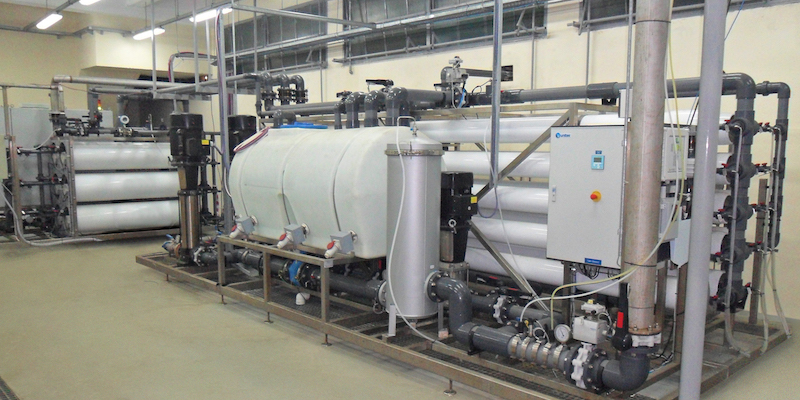
Optimizing an RO system for power generation starts with understanding the feedwater, selecting the right pretreatment, managing energy consumption, and integrating RO with downstream polishing and water reuse technologies.
Getting the most from RO requires looking at the entire treatment train
Reliable water treatment is essential to efficient power generation. Whether it’s for boiler makeup water or cooling systems, power plants require consistent water quality to protect equipment, maintain performance, and support reliable operations.
Reverse osmosis (RO) is a key technology in many power generation water treatment systems. By removing dissolved salts, minerals, and other contaminants, RO can produce high-quality water for demanding applications. But achieving the best results requires more than simply installing an RO system.
Optimizing reverse osmosis for power generation starts with understanding the feedwater, selecting the right pretreatment, managing energy consumption, and integrating RO with downstream polishing and water reuse technologies.
Why RO Matters in Power Generation
Power plants often require high-purity water for applications such as boiler makeup, heat-recovery steam generators, cooling systems, and other process needs.
Impurities in feedwater contribute to scaling, corrosion, and equipment problems, which can lead to costly downtime and repairs. RO effectively removes dissolved solids and many contaminants before water moves into downstream treatment.
Fluence uses RO as part of integrated treatment systems designed to produce demineralized and ultrapure water for power generation applications. Depending on the feedwater and required finished-water quality, RO can be combined with technologies such as ultrafiltration (UF), electrodeionization (EDI), ion exchange, and gas transfer membrane (GTM) degasification.
1. Start With the Feedwater
RO design starts with the water entering the plant. Groundwater, surface water, seawater, brackish water, municipal water, and reclaimed wastewater can present very different treatment challenges. Hardness, silica, suspended solids, organics, biological activity, and total dissolved solids all influence membrane selection, recovery rates, pretreatment requirements, and operating conditions.
2. Optimize Pretreatment to Protect RO Membranes
Pretreatment is one of the most important factors in maintaining RO performance.
Ultrafiltration, for example, can remove suspended solids and other contaminants before water reaches the RO stage. This can reduce the fouling potential of the feedwater and improve the reliability of the downstream RO system.
One example comes from a Central Puerto power plant in Buenos Aires, Argentina. The plant needed to increase production of demineralized water for high-pressure boilers while reducing operating costs. Poor-quality river water presented a significant fouling challenge.
Fluence designed a treatment system combining ultrafiltration, reverse osmosis, and continuous electrodeionization (CEDI). The system produces approximately 295 gallons per minute of demineralized water, with final water quality reaching conductivity below 0.1 µS/cm and silica below 10 ppb.
At Central Puerto, clarification was unable to reduce the feedwater’s high silt density index enough to prevent RO membrane fouling. Fluence added ultrafiltration pretreatment, reducing SDI to below 3 and making RO a viable option for replacing the plant’s ion-exchange demineralization process.
3. Match RO Performance to the Application
Not every power generation application requires the same water quality.
Cooling tower makeup water, for example, might have different quality requirements than boiler makeup water. Designing the treatment train around the application prevents overtreating water and helps control costs.
For applications requiring very high-purity water, RO can serve as a primary desalination step, followed by additional polishing.
A typical treatment train might include:
UF Pretreatment → Two-Pass RO → EDI
This type of multibarrier approach can produce ultrapure water suitable for demanding power generation applications. Fluence’s ultrapure water systems can be configured to produce water with resistivity up to 16 MΩ·cm, or conductivity below 0.1 µS/cm.
4. Consider Energy Efficiency
Energy consumption is another important consideration when optimizing RO systems.
This is particularly significant for seawater desalination, where high-pressure pumps account for a substantial portion of energy consumption. Fluence incorporates energy-recovery technologies such as pressure exchangers and turbochargers into appropriate RO systems to recover energy from pressurized concentrate.
Pressure-exchanger technology can achieve efficiencies of up to 98% and reduce energy consumption by as much as 45%.
For power plants using seawater, brackish water, or other challenging sources, evaluating energy recovery during system design can help reduce long-term operating costs.
5. Design for Reliability and Redundancy
Power generation facilities cannot afford interruptions to critical water supplies.
RO systems can be designed with redundancy and modularity to support reliable operation and simplify maintenance. Treatment trains can be configured so that individual components can be serviced without taking the entire treatment process offline.
Fluence has applied this approach to power generation projects using modular and containerized treatment systems.
For example, a concentrated solar power plant in Israel uses a fully containerized system that combines UF and RO to treat blowdown water for cooling makeup. A second-pass RO system, GTM degasification, and CEDI polishing produce ultrapure water for boiler use. The system includes duty-standby redundancy to support reliability.
6. Look Beyond Fresh Water: Reuse and Recovery
Optimizing an RO system isn’t only about producing high-quality water. It can also be an opportunity to reduce freshwater demand.
Power plants can generate significant waste streams. Rather than treating these streams as worthless, advanced treatment can recover that water for reuse within the facility.
This approach can help power producers reduce freshwater withdrawals while increasing the value recovered from existing water resources.
7. Consider Modular RO for Space and Deployment Constraints
Power plants often need to upgrade or expand water treatment capacity without major changes to existing infrastructure.
Containerized and modular RO systems can provide flexibility when space, construction time, or installation requirements are constraints.
Fluence has supplied containerized ultrapure water systems for power plants, including more than 15 production modules for seven power stations. Each 20 m³/h production module was installed in two 40-foot shipping containers, allowing the systems to be deployed within a compact footprint.
Modular systems can also support phased capacity increases, useful for facilities with changing water-treatment requirements.
Building a More Efficient Power Generation Water System
An optimized RO system should be viewed as part of the larger water treatment process, not as a singular piece of equipment.
The most effective design considers:
- Feedwater quality and variability
- Pretreatment and membrane protection
- Required product-water quality and polishing
- Energy use, recovery, and operating cost
- Reliability, reuse, and future capacity needs
With an integrated approach, power producers can use RO to produce reliable, high-quality water while improving operational efficiency and reducing water and energy demands.
Ready to Optimize Your Power Plant’s RO System?
Fluence has decades of experience designing water and wastewater treatment solutions for power generation facilities. Its solutions include RO, UF, EDI, ion exchange, nanofiltration, water reuse, wastewater treatment, and ultrapure water production.
Whether you’re upgrading an existing water treatment system, evaluating a new RO installation, or looking for opportunities to increase water reuse, the right treatment strategy can make a significant difference in performance and operating costs.
Contact Fluence to discuss your power generation water treatment requirements.


