
In 2026, more and more existing wastewater treatment plants are operating near or at permitted capacity, and decentralized treatment is emerging as a potential solution to the problem.
Shifting demands are reshaping how utilities plan wastewater treatment
As demand for water service grows and existing wastewater treatment systems age, municipal wastewater planning is in a period of transition. Tighter regulatory timelines, uneven growth, and staffing constraints are adding pressure to traditional expansion strategies. At the same time, advances in treatment technologies and delivery models are giving utilities new ways to respond—particularly where centralized expansion is slow, risky, or misaligned with real-world conditions.
Aging Centralized Plants and Lagoon Systems
Central wastewater treatment plants and lagoon systems have long been mainstays of wastewater treatment, but many were designed for population sizes, loading rates, and discharge limits that are no longer applicable. Today, more and more of these assets operate near or at permitted capacity, leaving little room to absorb incremental growth without significant capital investment.
National assessments of wastewater infrastructure condition and capacity, along with findings from the Clean Watersheds Needs Survey, show that utilities face a broad backlog of treatment and conveyance needs.
Lagoon systems, which are common in rural areas, offer a good case in point. As demand grows, lagoons that once provided adequate treatment may struggle to remain compliant. Full replacement with new, centralized facilities is expensive and can take years to permit and finance, so utilities may opt for extending the life and capacity of existing lagoons. Approaches such as upgrading lagoon treatment with decentralized plants can improve performance within existing footprints.
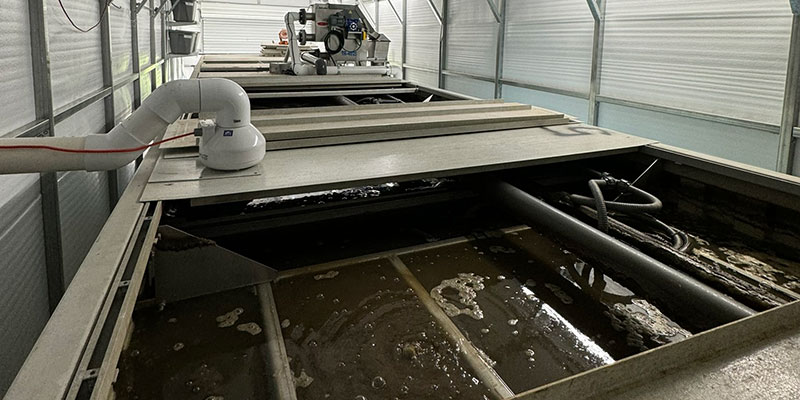
Decentralized treatment modules can be integrated into existing lagoon systems to improve nutrient removal and extend asset life without full plant replacement.
For example, a recent project in Dow City, Iowa, enhanced total nitrogen removal within a defined regulatory timeline by integrating additional biological treatment into an existing lagoon system. The modular membrane aerated biofilm reactor (MABR)-based plant met nutrient requirements while avoiding the cost, disruption, and long lead time associated with full replacement—reflecting a broader shift toward upgrade-in-place planning when legacy assets still have value.
Containerized Treatment in a Municipal Setting
Modular treatment platforms such as Aspiral™ Flex align closely with how decentralized wastewater systems are evaluated and deployed in municipal settings. Aspiral™ Flex is designed specifically for applications where treatment must fit within limited sites, operate near communities, and scale incrementally as service areas grow.
Its compact, fully containerized footprint requires less land than conventional plants, making it suitable for infill locations, satellite developments, and lagoon augmentation sites. Aspiral™ Flex operates with low odor and low noise profiles, allowing treatment to be sited close to residences, commercial areas, or civic facilities without disruption. The platform’s scalable modular architecture supports phased capacity additions, enabling utilities to match treatment investment to actual growth rather than overbuilding for long-range forecasts that may change.
Beyond physical footprint and performance, delivery and ownership models are increasingly part of how utilities evaluate decentralized solutions.
For utilities concerned about delivery and operational risk, Aspiral™ Flex can be provided through Fluence’s Water Management Services, which lets municipalities deploy treatment capacity without upfront capital investment and with performance aligned to service requirements.
Under this approach, Fluence retains responsibility for plant ownership, maintenance, and lifecycle performance, reducing the burden on utility staff while preserving operational reliability. By combining compact design, quiet operation, and modular scalability with flexible delivery options, Aspiral™ Flex functions as a practical building block for decentralized wastewater strategies that must simultaneously meet regulatory requirements, community expectations, and workforce realities.
Tighter Nutrient Limits and Enforcement Timelines
The tightening regulatory landscape is also driving interest in technologies designed specifically for nutrient compliance:
Nutrient regulation has become a dominant driver of planning. Nitrogen and phosphorus limits increasingly define permit conditions, compliance schedules, and capital priorities for wastewater utilities. Once permits are updated, utilities may face firm deadlines that leave limited flexibility to delay improvements while pursuing long-range expansion strategies.
In the United States, federal NPDES nutrient permitting requirements and documented state approaches to nutrient permitting reinforce this reality. Rather than aligning with long-term population forecasts, compliance obligations are tied to enforceable milestones. This timing mismatch places pressure on utilities to identify solutions that can be deployed incrementally and synchronized with regulatory deadlines, rather than relying solely on large projects with extended delivery schedules.
Fluence’s MABR technology is well-suited to these conditions, excelling in nutrient removal while significantly reducing energy consumption by aerating at near-atmospheric pressure. Effluent meets the world’s strictest standards, including China’s Class 1A and California’s Title 22. MABR can be pre-engineered into Aspiral™ Flex plants, along with numerous other stages and technologies for a fully plug-and-play experience that simplifies logistics and cuts total project cost.
Large Centralized Plants May Not Align With Growth
Population growth patterns complicate traditional wastewater planning assumptions. Infill development, satellite communities, and phased expansion at the edges of service areas rarely progress in a linear or predictable way. These patterns often require utilities to extend service incrementally, even when ultimate buildout remains uncertain.
Extending wastewater and water reuse service to dispersed growth may require long pipe runs and coordination across jurisdictions, rights of way, and permitting authorities before treatment capacity is even considered.
Recent analysis of U.S. water reuse infrastructure shows that pipeline infrastructure represents a substantial share of total project capital, particularly for reuse systems. When treatment and demand centers are far apart, the cost of moving the water can dominate project economics, undermining the feasibility of centralized approaches.
Utility Staffing and Operational Needs
Staffing and operational realities add another layer of pressure. Many public works departments and utilities operate with lean teams while facing retirements, recruitment challenges, and expanding regulatory workloads.
These limitations influence planning decisions directly. Large, complex facilities increase commissioning risk, training demands, and long-term operational burden at a time when utilities have fewer experienced operators available, pushing utilities to favor approaches that align capacity growth with operational realities.
In this context, decentralized systems are often evaluated not just for compliance or cost, but for how realistically they can be operated over time.
Together, these forces explain why municipal wastewater planning is changing in 2026. Aging assets, nutrient limits, uneven growth, conveyance risk, and workforce limitations interact in ways that challenge the assumption that centralized expansion alone provides the lowest-risk path forward.
Fluence works with utilities to design decentralized strategies that align compliance, capacity, and operational realities—helping communities move forward without overcommitting capital or staff. Contact Fluence to start mapping your decentralized path this year.


