
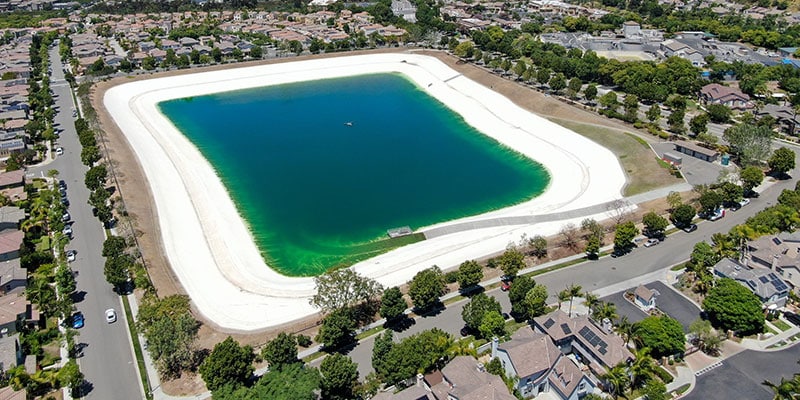
In lagoon- or reservoir-based wastewater treatment, removal of ammonia can be optimized by adding biofilm-only MABR wastewater treatment.
A nitrification-only approach to wastewater treatment focuses on doing one job — well
Membrane aerated biofilm reactor (MABR) systems are becoming increasingly widespread in wastewater treatment. A specific type of MABR — biofilm-only MABR — is designed with a clear purpose: efficient ammonia removal through nitrification. Rather than trying to address every aspect of nutrient removal, this technology focuses on doing one job well: converting ammonia into nitrate in a stable and energy-efficient way.
At its core, MABR is a biofilm-based process that uses a membrane to deliver oxygen directly to microorganisms. This unique approach eliminates the need for traditional bubble aeration and creates the conditions for consistent, reliable nitrification.
Opening the Box
Inside a biofilm-only MABR system, air is supplied on one side of the membrane and wastewater flows on the other. Oxygen, which makes up approximately 21% of air, passes through the membrane by passive diffusion. Unlike conventional systems, the process doesn’t rely on bubble aeration. Oxygen is delivered directly where it is needed.
A thin biofilm forms naturally on the surface of the membrane. This biofilm, typically only a few hundred microns thick, is where treatment occurs. Microorganisms in the biofilm take in oxygen from the membrane side and ammonia from the water side. As they consume oxygen, the microorganisms maintain a gradient that keeps it moving through the membrane.
Within two or three weeks, the biofilm becomes established and stable. With light, intermittent mixing, it stays active without excess buildup or performance loss.
A Solution Built for Nitrification
MABR is commonly applied alongside activated sludge systems for total nitrogen removal. In contrast, biofilm-only MABR is a more focused configuration designed specifically to convert ammonia into nitrate.
While some denitrification can occur in certain conditions, that is not the primary purpose in these applications. Taking a focused approach like this makes it easier to design and operate. Instead of balancing multiple biological processes at once, the system concentrates on doing one job well.
Why It Works
The efficiency of MABR stems from the way oxygen is delivered. Because it diffuses directly into the biofilm, nearly all of it is used. This means less energy demand than with traditional aeration, where a portion of oxygen is lost as bubbles rise to the surface.
This approach provides stability. The biology is attached to the membrane, so it stays in place, even when conditions change. Fluctuations in flow, temperature, or ammonia levels have less impact on this approach than on systems that rely on suspended microorganisms.
Another advantage is reduced greenhouse gas emissions. One of the stages of nitrification produces nitrous oxide, an environmentally hazardous gaseous form of nitrogen with 300 times the global warming potential of carbon dioxide. The fact that the nitrification process occurs in the biofilm reduces the release of this gas to the atmosphere and helps reduce overall greenhouse gas emissions, particularly nitrous oxide.
Where It Fits
Biofilm-only MABR works well in situations where reliable ammonia removal is needed without added complexity.
It is commonly used in lagoon systems to help maintain ammonia compliance, especially in colder conditions when biological activity slows down. It can also be added as a polishing stage to provide additional ammonia removal after the use of existing secondary biological treatment processes that lack nitrification capacities, all without major infrastructure changes.
Biofilm-only MABR produces negligible sludge (less than 5 ppm), mostly from the sloughing of biofilm from the membrane. Because of this, the solution requires limited operator attention, so it’s a h3 fit for smaller or more remote facilities.
What’s Really in the Box
At the end of the day, MABR is not trying to solve every treatment challenge at once. It offers a more focused solution.
Inside the box is a system built around:
- Passive oxygen transfer
- A stable, attached biofilm
- A clear purpose: efficient ammonia removal
It is a simpler way to approach a common problem, using less energy and requiring less operational effort. And that’s really what’s in the box — a nitrification system designed to do its job well.
For more information on how this approach can fit with your enterprise’s needs, contact the experts at Fluence.


